
|

|



CARD READING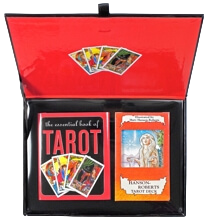
For those beginning to explore magic, I often recommend a particular tarot deck—the Hanson‑Roberts Tarot. It is the most beautiful set I’ve ever encountered, with gentle, expressive faces and artwork that feels warm rather than intimidating. The cards are small enough to handle comfortably and easy to carry in a pocket, making them ideal for daily use. The accompanying hardcover guidebook, written by Mary Hanson‑Roberts herself, offers interpretations that feel far more aligned with the true spirit of the deck than the generic instructions often packaged with tarot cards. Used properly, tarot cards function much like the “Sharpen” button in a graphics program. When you sharpen an image, the software replaces gradual shifts in color with clearer, more defined edges. The picture becomes easier to interpret because the details stand out. Tarot does something similar within the mind. It brings into focus insights you already hold but have not yet brought into conscious awareness. The symbols act as mirrors, reflecting truths that were previously blurred or hidden. Often, a tarot reading reveals what the client already knows deep within but has avoided acknowledging—sometimes because the truth is painful, sometimes because it requires change. For this reason, tarot should be used with compassion. The goal is not to shock or expose, but to help someone move toward a clearer understanding of their life and to equip them with the tools needed to navigate it wisely. |
RUNE STONES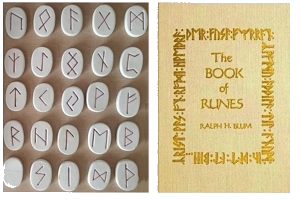 Runes have existed for nearly two thousand years. Originally an alphabet used across northern Europe—in Denmark, England, Germany, Hungary, Norway, Poland, Russia, and Sweden—they carried both linguistic and symbolic meaning. Each rune had a name such as “strong ox,” “gift,” “ice,” or “harvest,” and these meanings allowed the runes to be used for divination from the moment they were created.
Today, runes are primarily used as a guidance tool. A typical reading involves scattering the stones and observing how their positions relate to one another. The process engages the subconscious mind, allowing it to express insights that may not surface through ordinary thinking. Many people begin by asking a specific question, then interpret the runes in relation to that question. Your subconscious plays a central role. It influences how your hands release the stones and how your mind interprets their arrangement. In this way, runes help bring deeper understanding to the surface—insight that was already within you but waiting for a symbolic language to reveal it. As with any form of divination, it is important to learn from someone who speaks from genuine awareness—someone whose intuition is grounded in experience and whose connection with Spirit runs deep. Ralph H. Blum, author of The Book of Runes , is one such teacher, and his work remains a trusted guide for many. |
WAKE UP IN YOUR DREAMS!
A gentle, practical way to become lucid Lucid dreaming is the art of realizing you’re dreaming while the dream is happening—and doing so with enough clarity to participate in it. Not by forcing control, but by becoming conscious inside the landscape of your own mind.There are many websites, books, and forums for those trying to learn this skill. Most are taught the same method: perform a “reality check” during the day that should fail in waking life but might succeed in a dream. The classic example is trying to push a finger through your palm. The problem is simple: if you practice a test that always fails while awake, you train your mind to expect failure. And the mind is obedient. When you try the same test in a dream, it often fails there too—not because lucid dreaming is hard, but because you’ve rehearsed the wrong expectation. There’s a better way. A test that works in waking life—but fails in dreams Dreams can be vivid, emotional, and astonishingly real, but they have one consistent limitation: the brain cannot generate rapid, precise changes in brightness. The “dream screen” is slower than waking perception.
That’s why a small, three‑inch flasher becomes such a powerful tool.
That doorway is lucidity. How to train your mind gently This method works because it builds a simple, reliable pattern:
Here’s a safe, grounded way to begin: 1. Place flashers where your life naturally happens Keep one in your pocket, one on your desk, one by your bed, one where you eat, one in the bathroom. The goal isn’t discipline—it’s familiarity. You want the test to become part of the rhythm of your day.2. Each time you test it, assume you might be dreaming Not dramatically. Not with strain. Just a quiet openness:“If this doesn’t flash, I’ll check further.” This teaches your mind to carry the same attitude into your dreams. 3. When the flasher behaves normally, continue your day You’re reinforcing the expectation that the test always works.4. When it fails in a dream, pause and confirm Have a second indicator ready—something gentle and unmistakable.For me, it’s stepping outside and looking at the sky. If I’m imagining flying saucers while I look, they appear. That’s enough to know. Choose something that feels safe and natural to you. What becomes possible once you’re lucid Lucid dreams aren’t just entertainment. They’re a space where imagination and intelligence meet—where the mind can explore, practice, heal, and create.People use lucid dreams to:
After waking, you can re‑enter the dream from the perspective of another character. This can reveal motivations, emotions, and insights you didn’t have access to before. I’ve learned profound truths about people I love through this simple shift in viewpoint. Why this works Lucid dreaming isn’t about escaping reality. It’s about expanding your relationship with your own mind. When you train your attention gently—without fear, without pressure—you begin to notice the places where consciousness is already flexible.
The flasher is not magic by itself.
And once you can stand in that doorway, you can walk through it. |